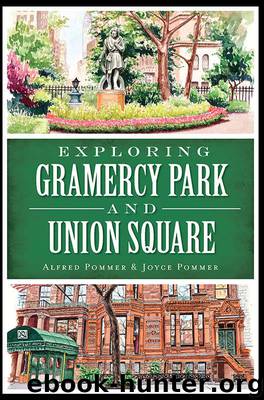
Exploring Gramercy Park and Union Square (History & Guide) by Pommer Alfred & Pommer Joyce
Author:Pommer, Alfred & Pommer, Joyce [Pommer, Alfred]
Language: eng
Format: epub
Publisher: Arcadia Publishing Inc.
Published: 2015-10-26T04:00:00+00:00
No. 16 Gramercy Park South, the Players Club (formerly the Edwin Booth Mansion).
Theater historians consider Edwin Booth America’s greatest tragic stage actor. His father was Junius Brutus Booth, a touring Shakespearean star and an eccentric drunk known as the “mad tragedian.” Edwin’s youngest brother was John Wilkes Booth, the man who assassinated Abraham Lincoln. Edwin Booth was a staunch Unionist and voted for Lincoln; his brother John was a rabid secessionist. After the assassination, Edwin was distraught. He stopped his stage appearances and wrote a letter of public apology. After several months, he returned to the stage. Edwin had three brothers, a sister and a half brother in England, and their sympathies were divided between the North and the South. Three of the brothers—Edwin, Junius Brutus Jr. and John Wilkes—appeared on stage together only once during their long theatrical careers.
They appeared in Julius Caesar on November 25, 1864, at the Winter Garden Theater on Mercer Street (between Bleecker Street and West Third Street) in Manhattan. It was a one-time, sold-out performance, and the proceeds went to erect the statue of Shakespeare (1564–1616) by sculptor J.Q.A. Ward on Literary Walk in Central Park. The cornerstone for the statue was laid by Edwin Booth in 1864 to celebrate the 300th anniversary of Shakespeare’s birthday, but the dedication wasn’t until 1872.
Download
This site does not store any files on its server. We only index and link to content provided by other sites. Please contact the content providers to delete copyright contents if any and email us, we'll remove relevant links or contents immediately.
| Africa | Americas |
| Arctic & Antarctica | Asia |
| Australia & Oceania | Europe |
| Middle East | Russia |
| United States | World |
| Ancient Civilizations | Military |
| Historical Study & Educational Resources |
Cat's cradle by Kurt Vonnegut(15441)
Pimp by Iceberg Slim(14666)
4 3 2 1: A Novel by Paul Auster(12512)
Underground: A Human History of the Worlds Beneath Our Feet by Will Hunt(12145)
The Radium Girls by Kate Moore(12093)
Wiseguy by Nicholas Pileggi(5841)
The Fire Next Time by James Baldwin(5503)
Perfect Rhythm by Jae(5461)
American History Stories, Volume III (Yesterday's Classics) by Pratt Mara L(5337)
Paper Towns by Green John(5247)
Pale Blue Dot by Carl Sagan(5080)
A Higher Loyalty: Truth, Lies, and Leadership by James Comey(5017)
The Doomsday Machine by Daniel Ellsberg(4545)
The Mayflower and the Pilgrims' New World by Nathaniel Philbrick(4540)
Killers of the Flower Moon: The Osage Murders and the Birth of the FBI by David Grann(4488)
The Sympathizer by Viet Thanh Nguyen(4445)
Too Much and Not the Mood by Durga Chew-Bose(4386)
The Borden Murders by Sarah Miller(4381)
Sticky Fingers by Joe Hagan(4255)
